
Aug
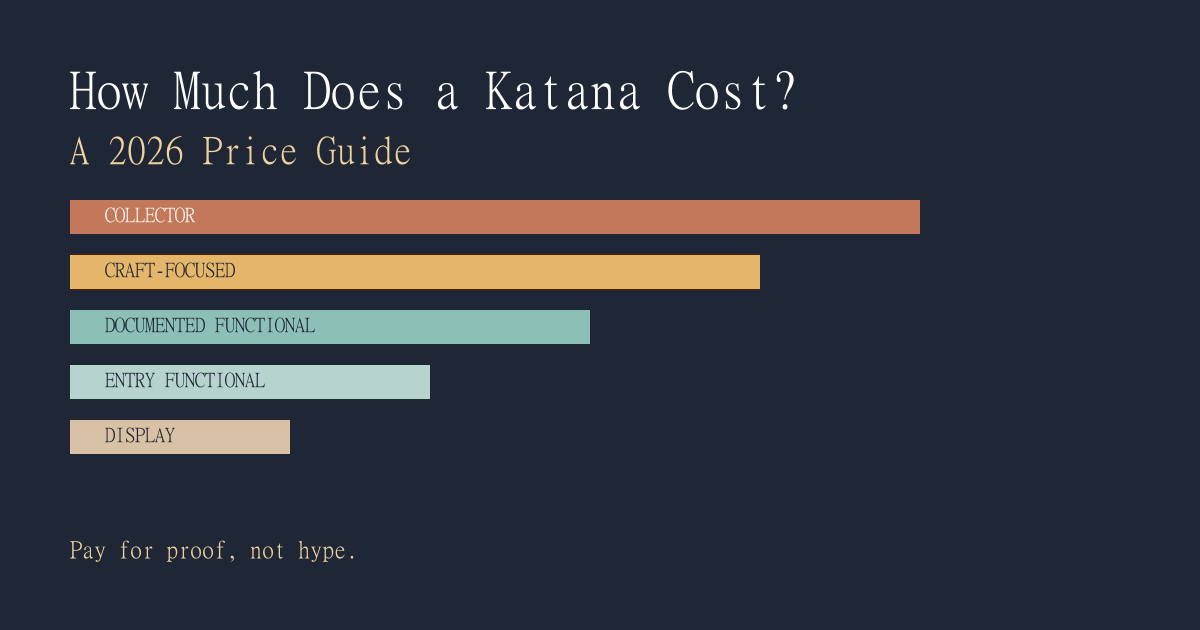
The short answer is that a katana can cost under $150 as a display-focused purchase, while a documented functional reproduction often belongs in the $150-$600 range. Quality-focused reproductions, custom work, and traditionally made Japanese swords can cost much more.
That range is wide because “katana” describes several different products. A decorative sword, a sharp functional reproduction, a collector piece, and a traditionally made Japanese sword should not be compared as if they were the same category. This guide gives you a practical price ladder, explains what each band may buy, and shows how to tell whether a listing has enough proof to justify its price.
Key Takeaways
- Under $150 is commonly a display or entry-level budget, so verify intended use before assuming a blade is functional.
- A $150-$500 budget gives many buyers more room to compare construction, steel, fit, and seller support.
- Steel affects price, but heat treatment, assembly, polish, fittings, and documentation matter too.
- “Real,” “battle ready,” and “premium” are claims to verify, not quality guarantees.
- A sharp sword requires responsible storage, handling, training, and compliance with applicable local rules.
How Much Does a Katana Cost? Quick Price Table
There is no universal katana price, but the following bands are a useful starting framework for buyers in the United States. They describe likely buyer tasks and the proof you should expect, not a promise that every product in a band has the same quality.
| Budget | Common buyer task | What may improve | What to verify |
|---|---|---|---|
| Under $150 | Display, costume, or cautious first look | Appearance and fittings | Intended use, assembly, materials, returns |
| $150-$300 | Entry functional purchase | Basic steel and construction options | Tang, heat treatment, fit, sharpness |
| $300-$600 | Better-documented functional ownership | Finishing, consistency, fittings, support | Specific proof, not only “premium” language |
| $600-$1,500 | Quality-focused reproduction or enthusiast ownership | Craftsmanship, polish, materials, maker detail | Actual product evidence and service policy |
| $1,500+ | Collector, custom, or traditionally made category | Provenance, maker, polish, historical value | Authentication, documentation, legal considerations |
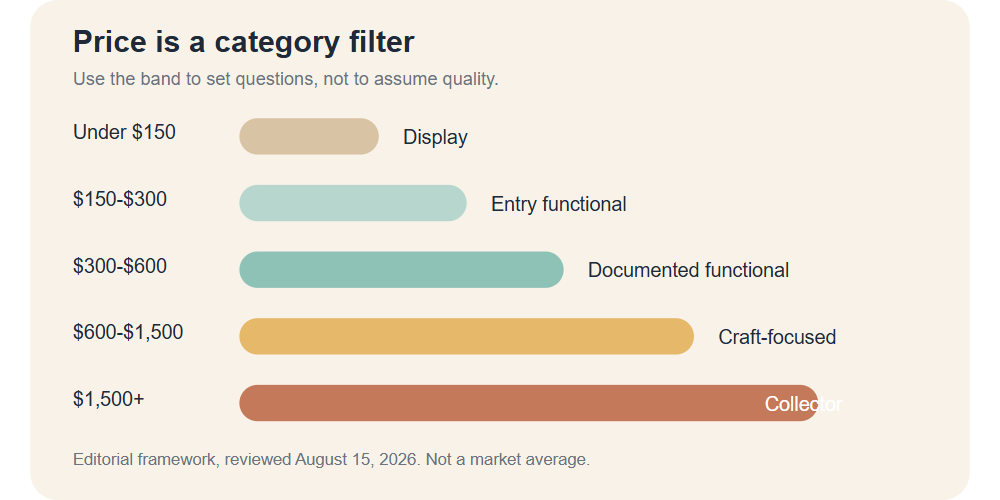
A higher band should buy stronger evidence, better finishing, or clearer provenance. It should not only buy more decoration.
What Do You Get Under $150?
Under $150, the safest assumption is that you are shopping for display, costume, or entry ownership unless the seller clearly documents functional construction. Some products in this band may look convincing, but appearance alone does not prove that a sword is designed for safe use.
Read the intended-use language first. If a listing emphasizes a stainless blade, decorative fittings, or a “samurai sword” theme without explaining tang construction, heat treatment, and assembly, treat it as a display product. A sharp blade without clear structural information is not automatically a bargain.
For a beginner who wants to learn basic movement, a bokken or another purpose-built training tool may be a better first purchase. A wooden or unsharpened training sword can reduce the risk of treating a sharp blade like a casual prop.
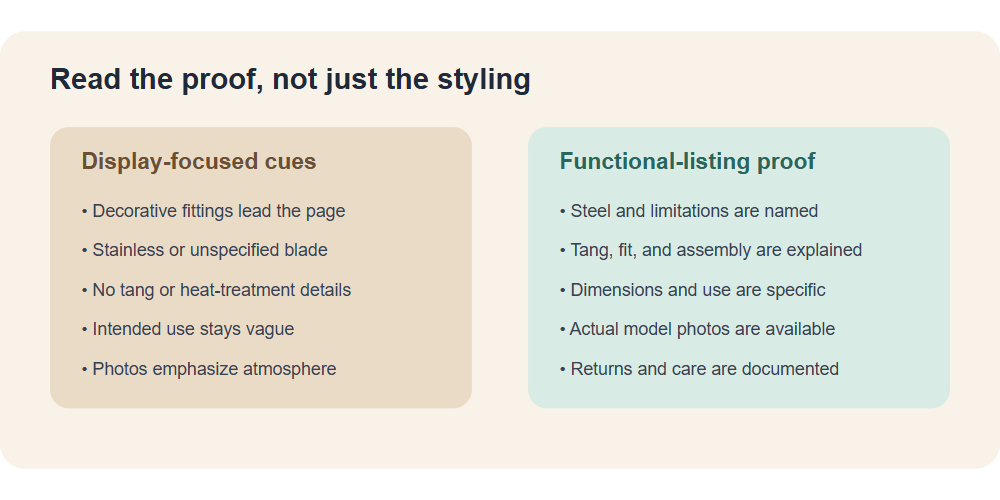
Before buying in this band, check the materials, dimensions, assembly language, return policy, and whether the photos show the actual model. If several answers are missing, pay for a safer category rather than paying for a dramatic description.
What Is a Reasonable Budget for a Functional Katana?
For many buyers, $150-$500 is a sensible comparison range for functional reproductions, but the right budget depends on use case and construction proof. A clearly documented 1060 blade can be a better buy than a vague “premium 1095” listing.
Public buying guides do discuss many 1060 functional swords around $100-$300 and many 1095 or T10 swords around $200-$500 (KatoKatana steel guide, retrieved August 15, 2026). Those are guide-reported ranges, not a reproducible market survey.
Steel is only one part of the price. A serious listing should also explain:
- Whether the blade is full tang or uses another construction.
- How the blade was heat treated, if that information is available.
- Whether the handle, guard, and fittings are secure.
- The blade length, weight, balance, and intended use.
- What maintenance the steel requires.
- What the seller will do if the product arrives damaged or inconsistent with the listing.
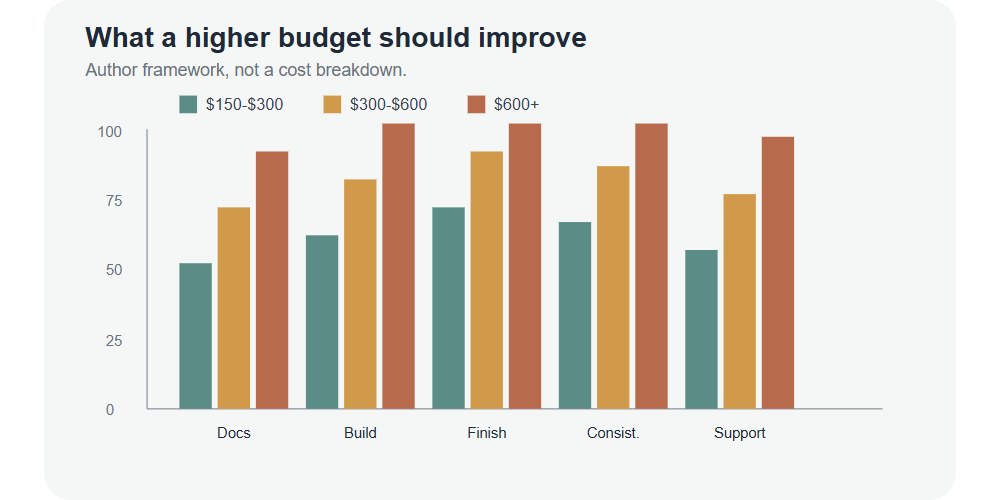
Price should increase the amount of proof and consistency you can expect. It should not replace verification.
Why Do Some Katanas Cost $600 or More?
Above roughly $600, buyers should expect stronger evidence of consistency, finishing, fit, materials, or provenance. A higher number by itself does not prove that the sword is better.
At this level, price may reflect a cleaner polish, better-fitted hardware, more consistent batches, a custom finish, or more detailed maker documentation. The saya, habaki, tsuka, and fittings may also receive more attention. These improvements can matter, but the seller should still explain what changed.
Sword Buyers Guide uses approximately $600 as a rough starting point in its discussion of genuinely high-quality katana (Real Katana Prices, retrieved August 15, 2026). Treat that as one guide’s benchmark, not as a universal threshold.
The collector category is different again. Traditionally made Japanese swords, often discussed under the term nihonto, are priced around maker identity, provenance, condition, polish, documentation, and legal or insurance requirements. “Real” does not mean one thing. It may mean sharp, functional, historically authentic, or traditionally made in Japan.
What Makes a Katana Expensive?
A katana should cost more when it offers better verified construction, finishing, materials, consistency, provenance, or service. Ornament can add value, but decoration should not hide missing technical information.
The main price drivers are:
- Steel and heat treatment: The steel name matters, but the finished blade depends on how the material was treated and shaped.
- Tang and assembly: A secure handle, sound fittings, and clear construction details are more useful than a vague “battle ready” label.
- Geometry and polish: Straightness, edge finishing, and surface work affect both appearance and the credibility of the build.
- Fittings and saya: Better materials and careful fit can add cost, especially when the details are documented.
- Maker and provenance: Custom work and traditionally made pieces need evidence of who made them and what the buyer is receiving.
- Seller accountability: Clear photos, returns, warranties, and after-sales support reduce buyer risk.
The central rule is simple: a high price without evidence is a marketing signal, not a quality signal.
How Much Does a “Real” Katana Cost?
The answer depends on what you mean by “real.” A sharp functional reproduction may cost hundreds of dollars. A historically authentic or traditionally made Japanese sword can cost thousands or much more. Those are separate markets with separate proof standards.
Do not use “real” as a synonym for expensive. A low-cost sword can be a real decorative product, while a high-cost sword can still be a poor purchase if the listing is vague. Ask whether the claim concerns sharpness, function, historical authenticity, or Japanese provenance.
For a functional reproduction, look for specific information about steel, tang, heat treatment, fit, dimensions, and intended use. For a collector purchase, add authentication, documentation, condition, maker details, and applicable legal requirements.
How Can You Tell If a Katana Is Worth Its Price?
Compare the listing’s proof against your use case before comparing its price against another listing. Use this checklist:
| Question | Strong signal | Risk signal |
|---|---|---|
| Intended use | Clear display, training, or functional description | “Real” or “battle ready” with no definition |
| Steel | Exact grade and relevant limitations | “Premium steel” only |
| Tang and fit | Construction and assembly explained | No tang information |
| Dimensions | Blade length, weight, balance, and photos | Dramatic claims without measurements |
| Product evidence | Actual model photos and consistent details | Generic images or copied specifications |
| Seller policy | Clear returns, warranty, and shipping terms | No remedy if the product differs |
If you cannot answer several checklist questions, do not solve the uncertainty by spending more. Choose a listing with better evidence, or choose a safer training category.
browse katana styles
compare functional sword options
Frequently Asked Questions
How much does a katana cost?
A katana can cost under $150 for display-focused ownership, around $150-$500 for many functional reproductions, $600-$1,500 for quality-focused or craft-focused pieces, and much more for collector or traditionally made categories. The correct budget depends on use case and proof, not only the number on the product page.
How much does a real katana cost?
A “real” katana can mean a sharp functional reproduction, a historically authentic sword, or a traditionally made Japanese sword. Functional reproductions may cost hundreds of dollars, while collector categories can cost thousands or more because provenance, maker details, condition, and documentation matter.
Is a $200 katana worth buying?
A $200 katana can be worth buying if the listing clearly explains its intended use, construction, dimensions, steel, fit, and seller policy. It is not worth buying simply because it says “battle ready” or “premium” without supporting details.
Are cheap katanas real?
Some inexpensive katanas are real display products or entry-level reproductions, but a low price does not tell you whether a blade is functional. Verify the category, materials, assembly, intended use, and return terms before you make assumptions.
How much should I spend on my first katana?
Start with the lowest band that matches your real use case. If you mainly want display, stay in a display-focused category. If you want to learn movement, consider a bokken or unsharpened trainer. If you want a sharp functional blade, budget for construction proof, maintenance, safe storage, and training, not just the sword.
Why are some katanas so expensive?
Higher prices may reflect better finishing, materials, consistency, maker documentation, provenance, or seller support. They may also reflect decoration or branding. Ask what evidence you receive for the extra cost before you treat a higher price as a quality score.
Conclusion
The best katana budget is the lowest price band that genuinely fits your intended use and includes enough construction proof to make a responsible decision. Display swords, training tools, functional reproductions, collector pieces, and traditionally made Japanese swords are different categories.
Start with the job. Then check steel, tang, fit, dimensions, maintenance, seller accountability, and safety. Steel is important, but it is not the whole price. A higher price should buy better proof, not just better adjectives.
When you are ready to compare options, browse katana styles.
Source Notes
- Internal TopKatana cluster plan, dated June 27, 2026. The “katana price” volume is directional planning data, not a live platform export.
- KatoKatana steel guide, retrieved August 15, 2026. Used only for guide-reported 1060, 1095, and T10 price ranges.
- Sword Buyers Guide real katana price guide, retrieved August 15, 2026. Used only as one published benchmark for high-quality katana discussion.
- Kult of Athena katana buyer basics, retrieved August 15, 2026. Used for the decorative versus functional category boundary.
Chinese Swords
Black Moon – Engraved High Manganese Steel Tang Dao | Dragon Scale Leather Saya | Battle Ready
Chinese Swords
“Nine Dragons” High Manganese Steel Fantasy Sword with Blue Engraved Blade & Leather Scabbard
Chinese Swords
Frost Wind – Baked Blue High Manganese Steel Xiuchun Dao | Silver Plum Motif | Battle Ready
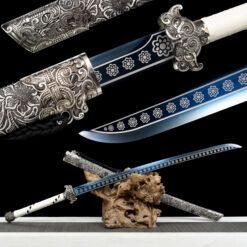
battle ready swords
Peacock Plume – Blue Manganese Steel Xiuchun Dao | Silver Floral Motif | Battle Ready
