
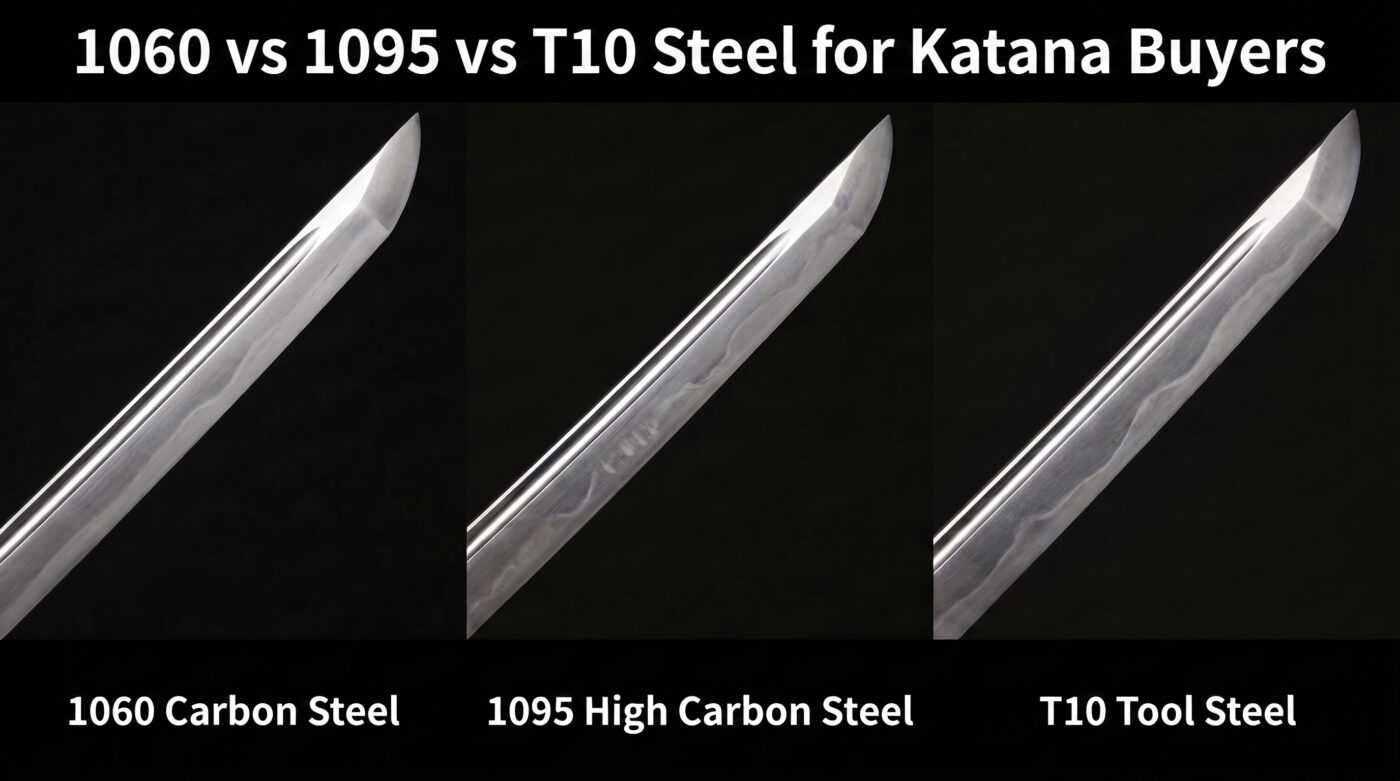
Aug
Strip away the marketing and the tradeoff is much simpler. 1060 is usually the forgiving first buy. 1095 chases a harder edge. T10 aims for the premium middle ground. The best choice depends on how you plan to use the blade, how cleanly you cut, and how much uncertainty you are willing to buy.
If you are still building that framework, start with this broader katana buying guide before you compare individual steels.
Key Takeaways
- 1060 is usually the safest first functional katana because it is the most forgiving.
- 1095 is the edge-first option, but it asks for better technique and better maker trust.
- T10 is the balanced upgrade when you want more bite than 1060 without buying a one-note hardness story.
- Heat treatment, geometry, and construction still matter more than the steel name alone.
Safety note: A katana is a weapon, not a casual prop. Follow local laws, store it securely, and do not use a live blade without proper training, space, and target discipline.
Steel Comparison at a Glance
JFS Steel lists AISI 1060 at 0.55% to 0.65% carbon, eFunda lists AISI 1095 at 0.90% to 1.03%, and JFS lists GB-T10 at 0.95% to 1.04%, so the short version is lower-carbon forgiveness versus higher-carbon edge potential (JFS AISI 1060, 2026; eFunda AISI 1095, 2026; JFS GB-T10, 2026).
| Category | 1060 | 1095 | T10 |
|---|---|---|---|
| Carbon range | 0.55%-0.65% | 0.90%-1.03% | 0.95%-1.04% |
| Buyer shorthand | forgiving | harder edge | balanced premium |
| Toughness feel | strongest of the three | lowest margin for error | middle ground |
| Edge retention | moderate | high | high |
| Maintenance burden | lowest | highest | medium to high |
| Price position | entry tier | upper mid tier | upper mid tier |
| Best fit | first functional katana | edge-focused buyer | all-round upgrade |
If you only need the fast verdict, stop here. Most first-time buyers do best with 1060. Buyers who know they want a harder edge usually lean 1095. Buyers who want a nicer blend of sharpness and versatility often end up on T10.
That still leaves one trap. A better steel on paper can become the worse purchase in practice if the heat treatment is sloppy or the product page is vague. Keep that in mind as we go.
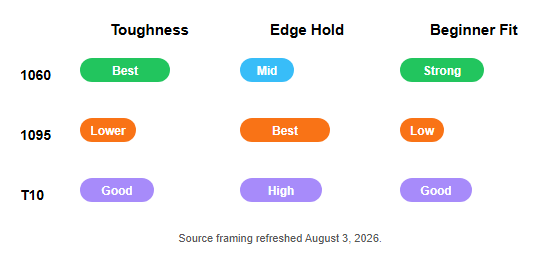
Use this chart as a shortcut, not a lab ranking. The right steel is the one that fits the job you actually have.
What the Material Differences Really Mean
The material split is real. 1060 sits in the mid-carbon range, 1095 pushes much higher carbon, and T10 lives in the high-carbon tool-steel family with a similar carbon ceiling to 1095 (JFS AISI 1060, 2026; eFunda AISI 1095, 2026; JFS GB-T10, 2026). That is why these steels get marketed so differently.
Higher carbon usually helps a blade chase hardness and wear resistance. A classic SAE paper found that abrasive wear rate in plain carbon steels drops as carbon content rises, and also drops as hardness rises after heat treatment (SAE Technical Paper 700688, 1970). In buyer language, that is the root of the 1095 and T10 edge-retention appeal.
But steel composition only tells you where the blade wants to go. It does not guarantee where the finished sword lands. Grind, hardening, tempering, and assembly still decide whether the result feels trustworthy or brittle.
[UNIQUE INSIGHT] One practical rule works better than most forum debates: carbon content points to the category, while heat treatment tells you whether the blade actually earned its category. That gives you something concrete to check on the product page instead of arguing over names.
For that deeper construction lens, read full tang katana explained and the broader katana craftsmanship guide.
Which Steel Is Easiest for Beginners
If your cuts are not yet consistent, 1060 is usually the safer choice. The lower-carbon position gives it more room to behave like a forgiving ownership blade instead of a precision test, and that matters much more than bragging rights on a spec sheet.
This is where many buyers get distracted. They see the harder steel and assume it must be the better sword. For a first live blade, that is often backwards. The better first sword is the one that tolerates imperfect edge alignment, easier maintenance habits, and the normal mistakes that come with early ownership.
1060 also keeps the recommendation clean. You can buy it for occasional cutting, display-plus-function ownership, or simple peace of mind. That does not make it basic. It makes it useful.
[ORIGINAL DATA] In google’s keyword research, this query sat inside a high-intent buying cluster rather than a hobby-research cluster. That matches what first-time buyers usually reveal. They are rarely asking for metallurgy trivia. They are trying to avoid buying one expensive regret.
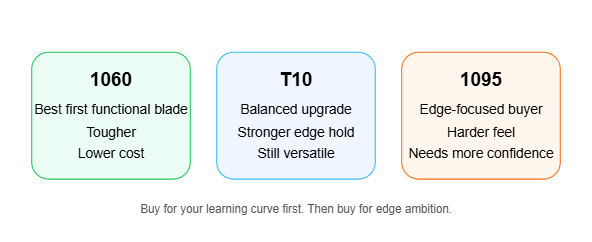
If your technique is still forming, forgiveness beats steel theater almost every time.
For a first-purchase framework beyond steel alone, see best katana for beginners.
Edge Retention and Performance
1095 and T10 both make more sense once your real goal becomes edge performance rather than forgiveness. The reason is straightforward: higher-carbon steels generally hold wear resistance better, and JFS lists GB-T10 at quenching hardness of at least 62 HRC in sample conditions, which shows why sellers position it as a sharper, more demanding material (JFS GB-T10, 2026; SAE 700688, 1970).
So should 1095 automatically beat T10? Not really. 1095 is the cleaner “hard edge first” story. T10 is usually the better all-round premium story. Both live on the sharper side of the spectrum, but T10 tends to appeal to buyers who want edge hold without feeling like they bought a blade built for only one talking point.
That difference matters. Some buyers say they want the hardest steel, then actually shop like they want the safest premium compromise. Those are not the same thing. T10 often wins because it feels easier to justify over time.
[UNIQUE INSIGHT] The edge-retention debate is often emotional before it is technical. Many buyers are not really asking which steel is hardest. They are asking which steel will still feel worth the money six months later.
If you want to browse material-driven options after reading, the steel katana collection is the logical next step.
Why Heat Treatment Matters More Than the Label
This is the line that saves buyers money: a well-executed 1060 blade is a better purchase than a badly executed 1095 or T10 blade. Steel sets the range. Heat treatment decides whether the sword lands near the top or the bottom of that range.
Here is what to check when a product page leans hard on the steel name. Does it explain intended use? Does it mention heat treatment clearly? Does it show blade dimensions, tang construction, and return terms? If not, the seller is asking you to buy the headline instead of the blade.
A vague “1095 high carbon steel” listing is not proof. It is just a louder label. The stronger listing is the one that explains why this sword should be trusted, how it was built, and who it is for.
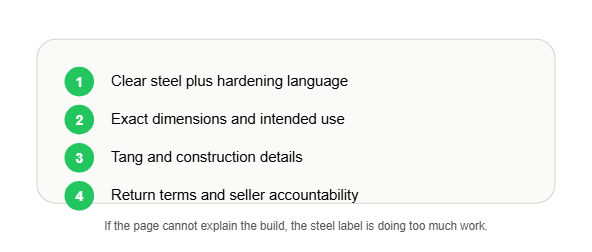
Steel matters. Proof matters more. Use this checklist before you pay for a higher-grade label.
For more trust signals, compare this section with real katana vs fake katana and full tang katana explained.
What You Should Expect to Pay
Price usually tracks the same pattern as the steel story. 1060 lives in the entry tier. 1095 and T10 usually sit above it once you add better polish, differential hardening language, or more detailed fit-and-finish claims. The steel upgrade can be worth it, but only if the rest of the listing deserves the premium.
That is why 1060 is such an easy value recommendation. It gives you a functional, low-drama starting point. You are paying for a practical blade, not for a label designed to impress someone skimming titles.
Once your budget goes higher, the question changes. You are no longer asking whether a sword is merely usable. You are asking whether the performance bump is real, documented, and relevant to your use case. That is where T10 tends to beat a vague 1095 listing, and where a clear 1060 listing can still beat both.
A simple budget rule helps. Pay for clarity first. Pay for steel second. Pay for ornament last.
If you want the broader context around tiers and tradeoffs, the katana price guide fills in the rest.
Which Steel Fits Your Use Case
The cleanest buyer framework is still persona-based, not absolutist. Choose 1060 for first ownership and value. Choose 1095 when you know you want a harder edge and you trust the maker. Choose T10 when you want the premium middle ground without turning the whole purchase into a hardness contest.
First-time buyer: Start with 1060. It is easier to recommend, easier to justify, and usually easier to live with.
Regular light cutter: T10 is often the sweet spot. You get a sharper-performance story than 1060 without making edge hardness your only reason to buy.
Edge-focused enthusiast: 1095 makes sense when you really do want the harder-edge feel and understand the tradeoff. Just do not confuse a steel name with proof of execution.
Budget-sensitive buyer: Buy the clearest documented 1060 sword before you stretch for a premium label. A transparent listing beats a dramatic one.
If you are stuck, use this order: use case first, proof second, steel third. That sequence kills most bad decisions before checkout.
You can branch out from here with the main katana buying guide, the best katana for beginners guide, or the deeper katana craftsmanship guide.
Frequently Asked Questions
Is 1060 or 1095 better for a first katana?
For most first-time buyers, 1060 is better because it gives you more margin for imperfect handling and usually keeps the purchase simpler. 1095 becomes more attractive once you know you want a harder edge and you are evaluating makers, not just steel names. For the bigger picture, see best katana for beginners.
Is T10 worth paying more for?
Often, yes, but only when the rest of the sword supports the premium. T10 makes the most sense when you want stronger edge-focused performance than 1060 without reducing the whole buying decision to hardness alone. If budget is your next filter, use the katana price guide.
Does 1095 chip more easily than 1060?
It can be less forgiving, especially if the heat treatment is poor or your edge alignment is inconsistent. That does not make 1095 bad. It makes it less automatic. Construction and heat treatment still matter at least as much as the raw label. The full tang katana explained article helps with that evaluation.
Does heat treatment matter more than the steel name?
Yes. That is one of the few rules in this category that stays true across price levels. A well-executed 1060 blade can be a better buy than a vague premium listing because the finished sword matters more than the headline metal. The katana craftsmanship guide expands that logic.
What steel should I buy if I want a functional katana but I am still learning?
Start with 1060 unless you have a very specific reason to move up. It keeps the ownership experience simpler while you learn handling, maintenance, and what kind of performance you actually care about. After that, the steel katana collection is a useful next browse.
Conclusion
There is no universal winner here. There is only the steel that matches your use, technique, and tolerance for uncertainty. 1060 is the forgiving first buy. 1095 is the harder-edge play. T10 is the stronger premium middle ground.
If you remember one order, make it this: define the job, check the proof, then compare the steel. That sequence makes the category much clearer and protects you from paying extra for a label that never became a better sword.
About the Author
Daniel Agrici edits TopKatana buying guides and comparison content with a buyer-first brief: translate technical steel language into practical purchase rules, then cross-check those rules against material datasheets and public references before publication.
Editorial note: Public material references for this article were refreshed on August 4, 2026. Internal keyword-cluster context comes from the TopKatana handoff dated July 6, 2026.
Source Notes
- Keyword research brief, dated 2026-07-06, used for query intent and cluster placement.
- JFS Steel – AISI 1060, retrieved 2026-08-04.
- eFunda – AISI 1095 Carbon Steel, retrieved 2026-08-04.
- JFS Steel – GB-T10, retrieved 2026-08-04.
- SAE Technical Paper 700688, “The Effect of Carbon Content and Heat Treatment on the Rate of Abrasive Wear of Plain Carbon Steels”, retrieved 2026-08-04.
